

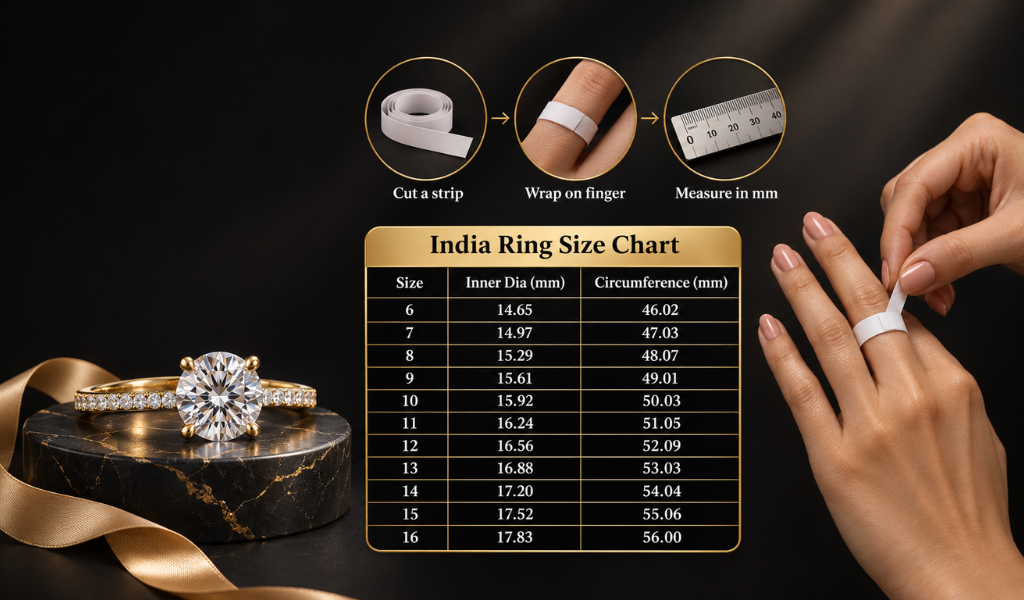

A ring is rarely just a piece of jewellery. It is the engagement ring that made someone say yes, the anniversary band that marks another year together, or the solitaire you bought yourself after a hard year of work. So when it arrives and does not fit, the disappointment is real.
The good news is that a wrong size is easy to avoid. All you need is a reliable ring size chart India, a thin strip of paper or thread, and ten quiet minutes. This ring size guide explains how Indian ring sizes work, how to find your ring size at home, and how to choose a fit that stays comfortable for years, whether you are buying a simple band or a lab grown diamond ring for a special moment.
Why the Right Ring Size Matters
Getting your size right is about comfort, safety and the life of the jewellery.
- A loose ring can slip off while washing hands, travelling or carrying a bag.
- A tight ring can leave marks and become hard to remove, especially in summer.
- A ring that keeps spinning puts extra stress on the setting, and a diamond may not sit facing up as it should.
- Resizing takes time, and some designs cannot be resized easily at all.
This is even more important for diamond jewellery. Rings with stones set all around the band, such as eternity bands, are much harder to adjust later. Getting the size right the first time is the smarter route.
How the Indian Ring Size System Works
India uses a numerical scale, usually from size 1 to size 30. Each number is linked to the inner circumference of the ring, which is the distance around the inside of the band.
As a thumb rule, the Indian ring size is roughly the inner circumference in millimetres minus 40. A ring with a 52 mm inner circumference is close to size 12, and one with 60 mm is close to size 20.
- Most Indian women wear sizes between 10 and 14.
- Most Indian men wear sizes between 18 and 22.
- Children and teenagers usually fall between 4 and 9.
These are averages only. Always measure your own finger.
Ring Size Chart India: Size 1 to 30 (in mm and inches)
Use this chart after measuring either the inner circumference or the inner diameter. Diameter is simply the circumference divided by 3.14.
| Indian Size | Inner Diameter (mm) | Inner Circumference (mm) | Circumference (inches) |
|---|---|---|---|
| 1 | 13.1 | 41.0 | 1.61 |
| 2 | 13.3 | 41.7 | 1.64 |
| 3 | 13.7 | 42.9 | 1.69 |
| 4 | 13.9 | 43.6 | 1.72 |
| 5 | 14.3 | 44.8 | 1.76 |
| 6 | 14.7 | 46.1 | 1.81 |
| 7 | 15.1 | 47.4 | 1.87 |
| 8 | 15.3 | 48.0 | 1.89 |
| 9 | 15.5 | 48.7 | 1.92 |
| 10 | 15.9 | 50.0 | 1.97 |
| 11 | 16.3 | 51.2 | 2.02 |
| 12 | 16.5 | 51.9 | 2.04 |
| 13 | 16.9 | 53.1 | 2.09 |
| 14 | 17.3 | 54.4 | 2.14 |
| 15 | 17.5 | 55.1 | 2.16 |
| 16 | 17.9 | 56.3 | 2.22 |
| 17 | 18.1 | 57.0 | 2.24 |
| 18 | 18.6 | 58.3 | 2.30 |
| 19 | 18.8 | 58.9 | 2.32 |
| 20 | 19.2 | 60.2 | 2.37 |
| 21 | 19.4 | 60.8 | 2.39 |
| 22 | 19.8 | 62.1 | 2.44 |
| 23 | 20.0 | 62.7 | 2.47 |
| 24 | 20.4 | 64.0 | 2.52 |
| 25 | 20.6 | 64.6 | 2.54 |
| 26 | 21.0 | 65.9 | 2.59 |
| 27 | 21.4 | 67.2 | 2.65 |
| 28 | 21.6 | 67.8 | 2.67 |
| 29 | 22.0 | 69.1 | 2.72 |
| 30 | 22.6 | 71.0 | 2.80 |
Diameter vs Circumference: The Most Common Confusion
Many people measure correctly but read the wrong column.
- Diameter is the straight width across the inside of the ring.
- Circumference is the full length around the inside of the ring.
Check which one your chart uses before comparing numbers. If needed, convert with this formula: circumference = diameter × 3.14.
5 Easy Ways to Find Your Ring Size at Home
1. The String or Thread Method
- Take a thin, non-stretchy string or dental floss.
- Wrap it snugly around the base of your finger.
- Mark the point where the end meets the string.
- Straighten it and measure the length in mm with a ruler.
- Match the number with the circumference column in the chart.
The string should be snug but able to slide over your knuckle.
2. Measure a Ring You Already Own
If you have a ring that fits the same finger well, this is the fastest method.
- Place the ring on a ruler.
- Measure the inside width of the band, edge to edge, across the centre.
- Find this diameter in the chart and read your Indian size.
Always measure the inner edge, not the outer edge.
3. The Paper Strip Method
- Cut a paper strip about 10 cm long and 1 cm wide.
- Wrap it around the base of your finger and mark the overlap.
- Measure from the end of the strip to the mark.
- Compare the length with the circumference column.
4. Use a Printable Ring Sizer
Print the sizer at 100 percent scale (never “fit to page”), then place a ring on the circles or wrap the strip around your finger. Check the printed scale with a ruler before relying on it.
5. Visit a Local Jeweller
A quick visit is free and uses proper metal ring gauges. It is a good way to confirm your home measurement, especially before buying an engagement ring or a custom piece.
Best Time of Day to Measure Your Finger
Your fingers are not the same size all day. They tend to be slightly larger in hot weather, after exercise, after a salty meal and in humid conditions. They shrink a little in cold weather or when you are dehydrated.
- Measure in the late afternoon or evening.
- Avoid measuring right after a workout, a hot bath or holding something cold.
- Repeat on two or three different days and take the average.
In India, where summers, monsoons and winters feel so different, this step matters more than people think.
Does Every Finger Have the Same Ring Size?
No. Each finger is different, and so are your left and right hands.
- Thumb: usually the largest, often 4 to 6 sizes bigger than the ring finger.
- Index finger: usually 1 or 2 sizes larger than the ring finger.
- Middle finger: often similar to or slightly larger than the ring finger.
- Ring finger: the reference size for engagement, wedding and anniversary rings.
- Little finger: typically 3 to 4 sizes smaller than the ring finger.
Always measure the exact finger and hand the ring is meant for.
How Band Width and Ring Style Affect Fit
Two rings of the same size can feel different because of band width and design.
- Thin bands (2 to 3 mm): light, and usually fit true to size.
- Wide bands (6 mm and above): feel tighter, so many people go up one size.
- Solitaires and halo rings: the setting sits higher, so check that the ring does not tilt or twist.
- Cocktail rings: larger stones can feel heavier, so a snug but comfortable fit works best.
- Eternity and anniversary bands: stones run along the band, so accurate sizing is essential since resizing is difficult.
If you are unsure, ask your jeweller how that particular design fits.
Tips for Choosing the Perfect Fit
- Check your knuckle. Pick a size that crosses the knuckle with slight resistance but does not feel loose at the base.
- Aim for comfort, not tightness. A good ring slides on with gentle resistance and comes off with a light twist.
- Do the shake test. Gently shake your hand. If the ring moves a lot, it is too loose.
- Look for pinch marks. A deep, lasting mark means it is too tight.
How to Find a Ring Size Secretly (For Proposals and Gifts)
Planning a surprise engagement or an anniversary gift? Here are some discreet ideas:
- Borrow one of their rings, trace the inside on paper or press it into a bar of soap, then measure the impression.
- Check the size of a ring they already wear on the same finger.
- Ask a close friend, sibling or parent who may already know.
- Go slightly larger if unsure, because it is easier to make a ring smaller than larger.
Common Ring Size Mistakes to Avoid
- Measuring the outer diameter of a ring instead of the inner diameter.
- Using a stretchy, thick or slippery string.
- Measuring when your hands are cold, swollen or just after exercise.
- Reading the diameter number in the circumference column, or the other way round.
- Ignoring the band width and style of the ring.
- Measuring only once instead of repeating it on different days.
Can You Resize a Ring If It Does Not Fit?
Often yes, but not always. Plain bands can usually be adjusted by one or two sizes by a skilled jeweller. Rings with all-round stones, intricate engraving or eternity designs are much harder to change. A ring guard can fix slight looseness as a quick solution. Before you buy any ring online, always check the brand’s exchange and resizing policy.
Final Thoughts
The right ring should feel like it belongs on your hand: comfortable, secure and effortless. With this ring size chart India, a simple strip of paper and a little patience, you can measure your size at home and choose with confidence, whether it is a solitaire for a proposal, an anniversary band, or a certified lab grown diamond ring just for you.
Measure twice, check the chart carefully, and enjoy a ring that fits as beautifully as the moment it stands for.
FAQ's on Ring Size
1. What is the average ring size in India?
Most Indian women wear sizes between 10 and 14, while most men wear between 18 and 22. Always measure your own finger for accuracy.
2. How is ring size calculated in India?
Indian ring sizes are based on the inner circumference of the ring in millimetres. A quick estimate is to measure your finger’s circumference and subtract 40. For example, 52 mm gives about size 12.
3. How can I measure my ring size at home without a ring sizer?
Wrap a thin string or paper strip around your finger, mark the overlap, and measure the length in mm with a ruler. Then match it with the circumference column in the ring size chart India.
4. What should I do if I am between two ring sizes?
Choose the larger size, especially for wide bands or if you have prominent knuckles. A slightly roomy ring is more comfortable, and a ring guard can fix any looseness.
5. Does ring size change with weather or time of day?
Yes. Fingers can swell in heat, humidity or after exercise and shrink in cold weather. Measure in the evening and repeat on two or three different days for the best result.


