

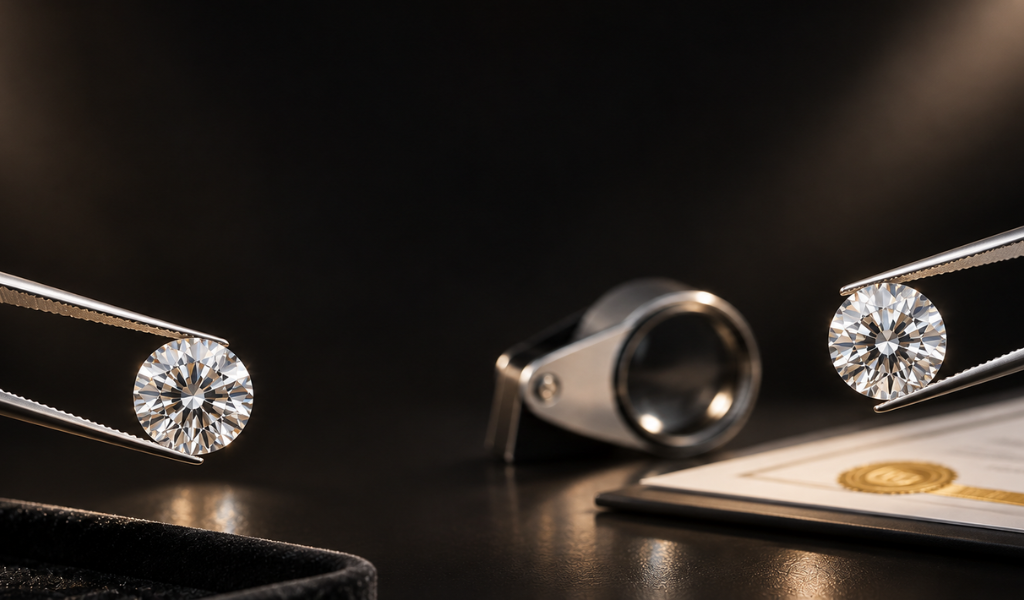

Buying a diamond is not something most people do every day. Whether it is for an engagement ring, a necklace or a pair of earrings, you want to know that the stone you are paying for is genuine. With lab grown diamonds becoming a popular choice, buyers often have questions about how they are made, how to identify them and what makes one different from an imitation stone.
A lab grown diamond is a real diamond, but its origin is different from that of a natural diamond. The challenge for buyers is that lab grown diamonds, natural diamonds and diamond simulants can look quite similar to the naked eye.
So, how can you be sure that the diamond you are buying is authentic?
The best place to start is with its grading report. You should also understand the diamond's quality, check its specifications and buy from a jeweller who provides clear information about the product.
Here is what you should know before making a purchase.
What Is a Lab Grown Diamond?
A lab grown diamond is created in a laboratory using technology that replicates the conditions required for diamond formation. It has the same chemical composition, crystal structure and physical properties as a natural diamond.
The difference lies in how and where it is formed. Natural diamonds develop beneath the Earth's surface over a very long period, while lab grown diamonds are produced in a controlled environment.
There are two main methods used to create them:
HPHT (High Pressure High Temperature): This process uses high pressure and temperature to create conditions similar to those in which natural diamonds form.
CVD (Chemical Vapour Deposition): In this method, a carbon-rich gas is used inside a specialised chamber. Carbon atoms gradually form layers of diamond crystal.
Both methods produce genuine diamonds. A Lab Created Diamond is not the same as cubic zirconia or other stones that are made to look like diamonds.
How to Verify Lab Grown Diamond Authenticity
A diamond may look beautiful in a jewellery display, but its appearance alone cannot confirm whether it is genuine. The following checks can help you understand what you are buying.
1. Ask for a Diamond Grading Report
A grading report is one of the first things to ask for when buying a certified lab grown diamond. It contains information about the stone, including its weight, measurements, colour and clarity.
Laboratories such as IGI (International Gemological Institute) and GIA (Gemological Institute of America) provide services for laboratory-grown diamonds. Their report formats and grading details may differ.
Before purchasing, check that the report clearly identifies the stone as laboratory-grown. Do not rely only on a product description or a verbal assurance from the seller.
2. Verify the Certificate Number
A grading report generally carries a unique report number. You can use this number on the issuing laboratory's official website to check the available report details.
Once you find the report, compare it with the information provided by the jeweller.
Pay attention to:
-
Report number
-
Diamond shape
-
Carat weight
-
Colour grade
-
Clarity grade
-
Measurements
-
Identification as a laboratory-grown diamond
-
Growth method, where mentioned
The information should match the details of the diamond you are considering. If something is different, ask the jeweller to explain it before placing your order.
3. Look for a Laser Inscription
Some certified lab grown diamonds have a microscopic inscription on the girdle, which is the narrow edge around the stone. It may contain the grading report number and other identifying information.
A jeweller can help you view this inscription under a microscope.
If an inscription is present, compare its number with the grading report. Keep in mind that not every diamond carries a laser inscription, so its absence does not automatically mean that the stone is not genuine.
4. Check Whether the Diamond Is Clearly Identified as Lab Grown
Read the grading report and purchase details carefully. The diamond should be identified as laboratory-grown rather than natural.
This distinction matters because both are real diamonds, but they have different origins and market pricing.
Make sure the product description, grading report and invoice provide consistent information.
Understand the 4Cs Before Buying a Lab Created Diamond
The 4Cs are used to describe the quality of a diamond. They stand for Cut, Colour, Clarity and Carat Weight.
Understanding these four factors will help you compare different diamonds instead of choosing one based only on its size or price.
Cut
Cut affects how a diamond reflects light. It influences the stone's brightness, sparkle and overall appearance.
A well-cut diamond generally has a lively appearance because its facets reflect light effectively. When comparing two diamonds, look at their cut grades and proportions rather than focusing only on carat weight.
Colour
Diamond colour is generally graded on a scale from D to Z.
-
D to F: Colourless
-
G to J: Near colourless
-
K to M: Faint colour
-
N to Z: Noticeable colour
Many buyers prefer colourless or near-colourless diamonds, but the right choice depends on personal preference and the jewellery design.
Clarity
Clarity describes the natural characteristics found inside or on the surface of a diamond. Internal marks are called inclusions, while surface marks are known as blemishes.
The commonly used clarity grades are:
-
FL – Flawless
-
IF – Internally Flawless
-
VVS1 and VVS2 – Very, Very Slightly Included
-
VS1 and VS2 – Very Slightly Included
-
SI1 and SI2 – Slightly Included
-
I1, I2 and I3 – Included
A higher clarity grade does not always mean that a diamond will look noticeably better. Some inclusions are difficult to see without magnification. It is worth checking the stone's appearance along with its grade.
Carat Weight
Carat refers to the weight of a diamond. One carat is equal to 200 milligrams.
A higher carat weight usually means a heavier stone, but it does not always mean that the diamond will look larger. Its shape, cut and measurements also affect how it appears when worn.
For this reason, check the measurements mentioned in the grading report before comparing diamonds of the same carat weight.
Lab Grown Diamond vs Cubic Zirconia vs Moissanite
Lab grown diamonds are sometimes confused with cubic zirconia and moissanite because all three can have a diamond-like appearance. However, they are different materials.
| Feature | Lab Grown Diamond | Cubic Zirconia | Moissanite |
|---|---|---|---|
| Composition | Carbon | Zirconium dioxide | Silicon carbide |
| Crystal structure | Diamond crystal structure | Different crystal structure | Different crystal structure |
| Mohs hardness | 10 | Around 8–8.5 | Around 9.25 |
| Is it a real diamond? | Yes | No | No |
Cubic zirconia and moissanite are commonly used as diamond alternatives. They may look similar, but they do not have the same composition as a diamond.
A simple visual check is not enough to distinguish all three reliably. A professional gemmologist can use specialised equipment to identify the stone.
Quality Checks to Make Before Buying
Apart from checking the grading report, spend some time looking at the diamond and understanding the product details. These checks are particularly useful when buying jewellery online.
Examine the Diamond in Different Lighting
Ask to see the diamond under normal lighting as well as jewellery display lighting. Notice how it looks when you move it and whether its overall appearance matches your expectations.
Jewellery display lights can make stones look particularly bright, so checking them in different conditions gives you a better idea of their appearance.
Compare the Measurements
Check the diamond's length, width and depth against the details in its grading report. This is useful when comparing stones with the same carat weight.
For online purchases, make sure the product specifications are clearly mentioned.
Ask About the Growth Method
Find out whether the diamond was produced using the HPHT or CVD process. This information may be included in the grading report or provided by the jeweller.
The growth method is useful background information, but it should not be the only factor in your decision. The diamond's final quality and grading details matter as well.
Check the Jewellery Metal
If you are purchasing a finished jewellery piece, check the metal used for the setting.
For example, confirm whether the ring, earrings or necklace is made with 14K or 18K gold. If it is gold jewellery in India, check the applicable hallmarking and purity details too.
The diamond and the metal should both be properly described in the product information and invoice.
Tips for Buying a Lab Grown Diamond Online
Buying diamond jewellery online gives you the convenience of comparing different designs and specifications from home. However, it is important to check a few details before confirming your order.
Choose a jeweller who provides clear information: Check the brand's contact details, customer reviews, product descriptions and after-sales support.
Ask about certification: If the diamond is advertised as certified, ask for its grading report and verify the report number through the issuing laboratory.
Compare the specifications: Make sure the carat weight, colour, clarity, shape and measurements match the grading report.
Read the return policy: Understand the conditions for returns, exchanges and refunds. Customised jewellery may have different terms.
Check the invoice: The invoice should clearly mention the jewellery details, diamond specifications and metal information.
Consider the complete design: Do not select a diamond based only on carat weight. Its cut, appearance and setting also affect how the finished jewellery looks.
Common Mistakes to Avoid
A few small oversights can lead to confusion when buying diamond jewellery. Keep these points in mind:
-
Do not assume that every sparkling stone is a real diamond.
-
Do not purchase a certified diamond without checking its grading report.
-
Do not rely only on a certificate image shared by the seller. Verify the report details through the issuing laboratory.
-
Do not confuse a lab grown diamond with cubic zirconia or moissanite.
-
Do not ignore the jewellery metal, invoice or return policy.
-
Do not choose a diamond only because it has a higher carat weight.
Taking time to check these details can make the buying process much clearer.
Final Thoughts
A lab grown diamond is a genuine diamond, but it is important to know exactly what you are purchasing. The grading report, report number, 4Cs and product specifications all help you understand the stone better.
Before making a decision, check the report through the issuing laboratory, compare its details with the actual product and ask the jeweller about anything that is unclear. If you are buying online, read the product description and return policy carefully.
A little knowledge can make a big difference, especially when you are choosing a piece of jewellery for an engagement, anniversary or another occasion that means a lot to you.
FAQ's
1. How Can I Check Whether a Lab Grown Diamond Is Genuine?
Ask for the diamond's grading report and verify its report number through the issuing laboratory's official website. You can also ask a qualified gemmologist to examine the stone using specialised equipment.
2. Do Lab Grown Diamonds Come With Certification?
Yes. Lab grown diamonds can be accompanied by grading reports from laboratories such as IGI and GIA. The report provides details about the diamond's characteristics and identifies it as laboratory-grown.
3. Can You Tell the Difference Between a Natural and Lab Grown Diamond by Looking at It?
No. Natural and lab grown diamonds have very similar physical and optical properties. Specialised gemmological equipment is generally needed to identify their origin.
4. Are Lab Grown Diamonds the Same as Cubic Zirconia?
No. A lab grown diamond has the same chemical composition and crystal structure as a natural diamond. Cubic zirconia is a different material that is used as a diamond substitute.
5. What Should I Check Before Buying a Lab Grown Diamond Online?
Check the grading report, verify the report number, compare the diamond's specifications and read the seller's return policy. Also confirm the jewellery metal, invoice details and after-sales support before placing your order.