

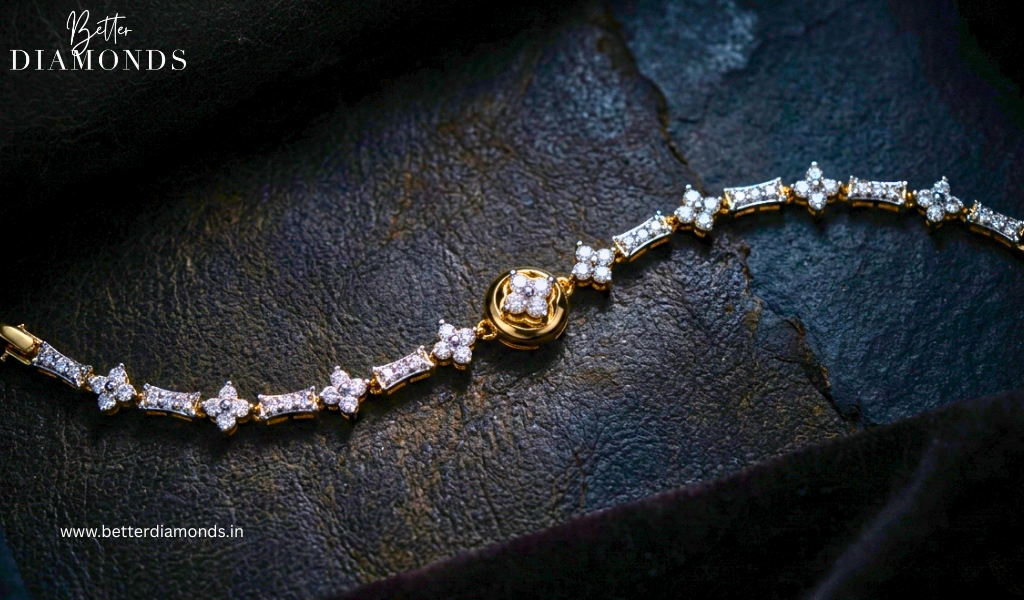

Walk into any jewellery store today and you will likely hear the salesperson ask one question early on: lab grown or natural? It is not a trick question, but it does trip up most first-time buyers. On the surface, both bracelets look identical, same shine, same sparkle under the light. The real story is in how they came to be, and that story changes the price tag, the certification paperwork, and even how you think about the piece years down the line.
So What Exactly Is a Lab Created Diamond Bracelet?
Instead of being pulled out of the earth, these diamonds are grown inside a lab using one of two processes, CVD or HPHT. Both essentially recreate the pressure and heat conditions found deep underground, just in a controlled setting and in a fraction of the time. A stone that would take nature a billion years to form can be grown in a matter of weeks.
Here is the part most people do not realise until they hear it directly from a jeweller: there is no chemical difference. A lab grown diamond bracelet, whether it is a simple everyday piece or something closer to a full tennis bracelet, is made of the exact same carbon structure as a mined stone. Certified lab grown diamonds go through the same grading process too, so you are not losing any credibility by choosing one.
And What About a Natural Diamond Bracelet?
This is the traditional route, diamonds mined from the earth after forming over billions of years under intense heat and pressure. They get cut, polished, and set the same way lab grown stones do. What natural diamonds carry that lab grown ones do not, at least for now, is a certain cultural weight. Many families still associate mined diamonds with heirlooms, with the idea of something rare being passed down.
Where the Two Actually Differ
Formation. One takes weeks, the other takes billions of years. That is the headline difference, and honestly it is the one buyers get stuck on emotionally, even though it does not affect how the stone looks or performs.
Price. This is usually the deciding factor for most people. Lab created diamond bracelets typically cost 30 to 40 percent less than a comparable natural stone. Mining is expensive, labour intensive, and comes with environmental costs that lab production simply avoids. If your budget is fixed but you want a bigger stone or a more elaborate lab created diamond tennis bracelet, this is where lab grown wins hands down.
Certification. Both types can be certified by labs like IGI and GIA. The certificate will state clearly whether the diamond is lab grown or mined, along with the usual carat, cut, colour, and clarity details. So there is no ambiguity here, you know exactly what you are buying either way.
Resale. Natural diamonds still hold an edge in the resale market, mostly because they have been around longer and the secondary market for them is more established. Lab grown diamonds have not built that same resale infrastructure yet. That said, if you are buying a bracelet to wear and enjoy rather than treating it as a financial asset, this matters a lot less than people assume.
Ethics and sustainability. A growing number of buyers, especially younger ones, are choosing lab grown diamond bracelets specifically because they sidestep the environmental and labour concerns tied to traditional mining. It is become one of the bigger reasons people switch.
Looks and durability. Practically zero difference here. Both score a 10 on the Mohs scale, both throw the same fire and brilliance, and both need the same basic care. Even an experienced jeweller cannot tell them apart just by looking, they need lab equipment to confirm origin.
Which One Should You Actually Pick?
If you want more sparkle for your money, or you care about where your diamond comes from, a lab created diamond bracelet makes a lot of sense. That covers everything from a subtle bangle-style piece to a full lab grown diamond tennis bracelet.
If rarity, tradition, or long-term resale matter more to you, a natural diamond bracelet is still the safer bet.
Neither choice is wrong. Both are genuine diamonds. It really comes down to what you personally value and what the bracelet means to you.
The Bottom Line
There is no universal right answer here, only what fits your budget, your values, and the occasion you are buying for. Lab grown diamonds have opened up fine jewellery to a lot more people without asking them to compromise on quality. Natural diamonds still carry that old-world charm for buyers who want it. Either way, you are walking away with a real diamond bracelet, not a substitute.
FAQ's
Q1. Are lab created diamonds real diamonds?
Yes. Lab created diamonds have the same chemical and physical properties as natural diamonds. They are real diamonds, not imitations.
Q2. Can lab created diamonds be detected by jewellers?
Only with specialised laboratory equipment. Visually and physically, they are identical to natural diamonds.
Q3. Do lab created diamond bracelets come with certification?
Yes. Reputable brands certify lab grown diamonds through labs like IGI and GIA, clearly stating their lab grown origin.
Q4. Is a lab grown diamond bracelet a good investment?
Lab grown diamonds are better suited for personal use and gifting rather than long-term investment, as their resale value is currently lower than natural diamonds.
Q5. Why are lab created diamond bracelets cheaper than natural ones?
They are cheaper due to lower production costs and shorter creation time compared to mining natural diamonds, without any compromise on quality or brilliance.